I reach down to the baggage carousel and slip the strap over my shoulder, the weight of a month’s traveling slowly spreading through my frame, equalizing itself. I pause. Something feels wrong. There is a dampness between my shoulder blades and a smell that doesn’t belong: windfall cherries, woodsmoke. I look down to see a small, red pool forming behind my heels. A man in a yellow jacket reaches for a walkie-talkie. The source is a now-leaking bottle of Fritz Wieninger’s Pinot Noir Select 2006, naively swaddled in pair-upon-pair of walking socks. It’s a memento of one of those evenings…
Tom came dangerously close to working in wine on two occasions. First, there were a few steps in the wine trade, pouring and selling, and then later a close call with a chalky, south-facing slope in Kent. As it happened, he found his home at the piano as a performer, composer, and educator in the realms of jazz and contemporary music. Two joyfully unpredictable fields seemed better than one, though, so he now writes about sparkling wine at sixatmospheres.co.uk, also having featured at timatkin.com, Falstaff, The Buyer, and The Drinks Business. He is currently preparing the largest ever single report on English wine for timatkin.com, due for publication in autumn 2021.
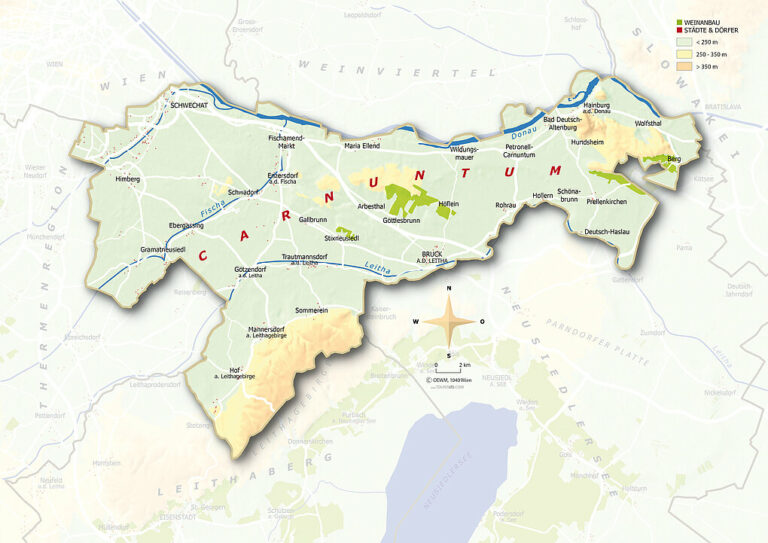
The little wine region of Carnuntum sits east of Vienna and south of the Danube. With a mere 900 hectares under vine, it distinguishes itself through an awareness of regionality developed early on. In 1992, when Austria was still largely classifying its wines by variety rather than origin, Carnuntum implemented the idea of a regionally typical red wine with the name Rubin Carnuntum. But reaching DAC origin status – oriented to the regional, village, single-vineyard wine concept – was still a long road away. This only took effect in 2019 and today Zweigelt Rubin Carnuntum is a regional wine. Although white…...
12/14/2020 Eat & TRINK | Alpkäse and Kamptal Riesling By Ursula Heinzelmann The entirely spontaneous, yet infinitely harmonious tinkling of cow bells. The crunching of my boots along a narrow mountain path. The joyous gurgling of a stream winding its way down among rocks, moss, and roots. This is one of my favorite cheese soundtracks. The accompanying “smelltrack” is of warm stables in the haze of first light and earthy, pungent bodies, redolent of the basic facts of life. Wood smoke rising from under a round copper vat. And of course the reassuring, lactic aroma of warm milk and whey,…...
In 2013, I moved to Austria and spent most of a year living in the small town of Eisenstadt. There were several cultural difficulties to surmount, not least the language. Despite my decent grasp of German, I found the Austrian dialect all but impenetrable for the first few months. And then there were the drinking customs. Because Austria had forged an impressive international reputation for elegant, high-quality wines, I expected to spend my time savoring delicious Blaufränkisch, or getting to know the top single-vineyard sites of the Wachau. But everywhere I went people just drank a mix of cheap white…...
Why does biodynamics matter? Respekt-BIODYN is the ongoing effort of 25 growers from German-speaking wine regions to answer that question. Though there are many forms of holistic farming that benefit people, planet, vines and wines, this tight-knit Austria-based group believes that a shared commitment to viewing the teachings of philosopher and agricultural reformer Rudolf Steiner as a springboard for exchange, cooperation, shared learning, and support helps cultivate a sense of individuality that, ultimately, translates into more profound terroir expression and higher quality in their wines. Biodynamic Origins “The first 12 winemakers started in 2005,” explains the group’s leader, Michael Goëss-Enzenberg…...