It’s hard to believe now, but Germany was once a divided country, and the East was a strange microcosm of icons of that era: Sandmännchen, Jungpioniere, and FKK-Kultur. Not to forget its sparkling ambassador, Rotkäppchensekt. Also hard to believe: a destination for wine fans has now arisen in the area between Chemnitz and Cottbus, Magdeburg and Dresden. And yet, from Berlin, the trip takes you almost 200 kilometers to the south, past Dessau and Lutherstadt Wittenberg, to a place whose name sounds to German ears disturbingly close to “Lauch” (leek). Laucha an der Unstrut has roughly 3,200 inhabitants, a bell museum, and one…
Eva Biringer, born in southern Germany, studied art history and theater studies. She writes about food, travel, and feminism for publications like Zeit, Zeit Online, Welt, Feinschmecker, and many more. She currently lives in Berlin.
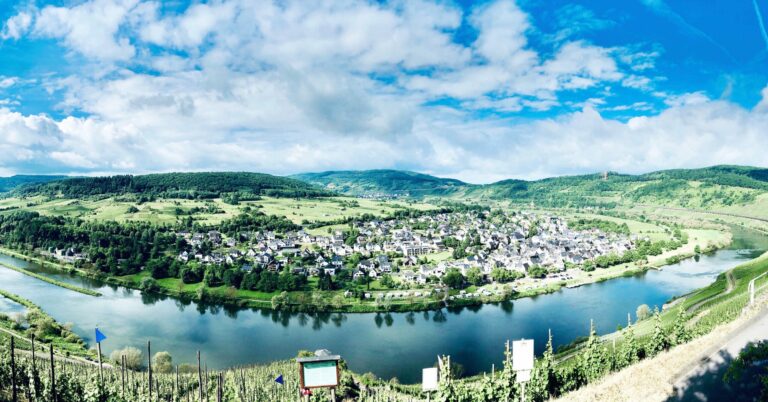
The Mosel, Germany’s oldest winegrowing region, knows how to beguile. The Rheingau swathes itself in the trappings of nobility, Baden boasts of its sunshine, the Mittelrhein beckons with Romanticism. The Mosel, however, reaches straight for myth. There are many recaps of the growing region readily available, so let’s focus on something else instead: what makes the Mosel unique — now, then, and, likely, in the future. Not for nothing is the biggest annual wine fair along the Mosel River entitled “Mythos Mosel.” The name, and the event itself, attest to the enduring power the Mosel holds in the imagination of the wine-drinking…...
There’s no end to writings about how wine affects people. It begets relaxation and well-being, of course, but also stimulating discussion. The right bottle can be just the spark needed to light up a dull evening. But can certain wines channel our moods and perceptions — our very psychology — in different ways? This question was often posed by Wolf-Dietrich Salwey, a vintner who passed away in a car accident in 2011. Known for his unconventional character, Salwey routinely invited neighbors, colleagues, and friends to his estate in Oberrotweil in the Kaiserstuhl to explore the influence of specific grape varieties…...
Liora Levi, high-profile sommelier, television personality, and president of ASI Norwegian Sommelier Association, came late to wine. In its own odd way, that only bolsters her bona fides as a daughter of the north. The countries to the north of the umlaut region can generally be viewed as latecomers to the joys of wine, and white wine in particular. But times change, and opinion makers like Levi have now helped the Nordics become prime drivers of the Riesling Revolution. It is a boom time for whites under the northern lights. As Levi explains in an interview with TRINK, the delayed…...
Her child, she thinks, is a Riesling. Of all the varieties in the world, she inevitably returns to this one. There is something in the grape’s singular ability to convey fragility and strength, ephemera and eternity, that mirrors motherhood and frames the child in her mind’s eye. The child could have reflected a multiple of varieties, a blend perhaps, or a different hue. She remembers a strawberry-scented evening of pink Cinsault in a South African game lodge, bottomless glasses as sundowners, followed by a queasy morning-after, and a realization that the child — then little more than a flicker —…...