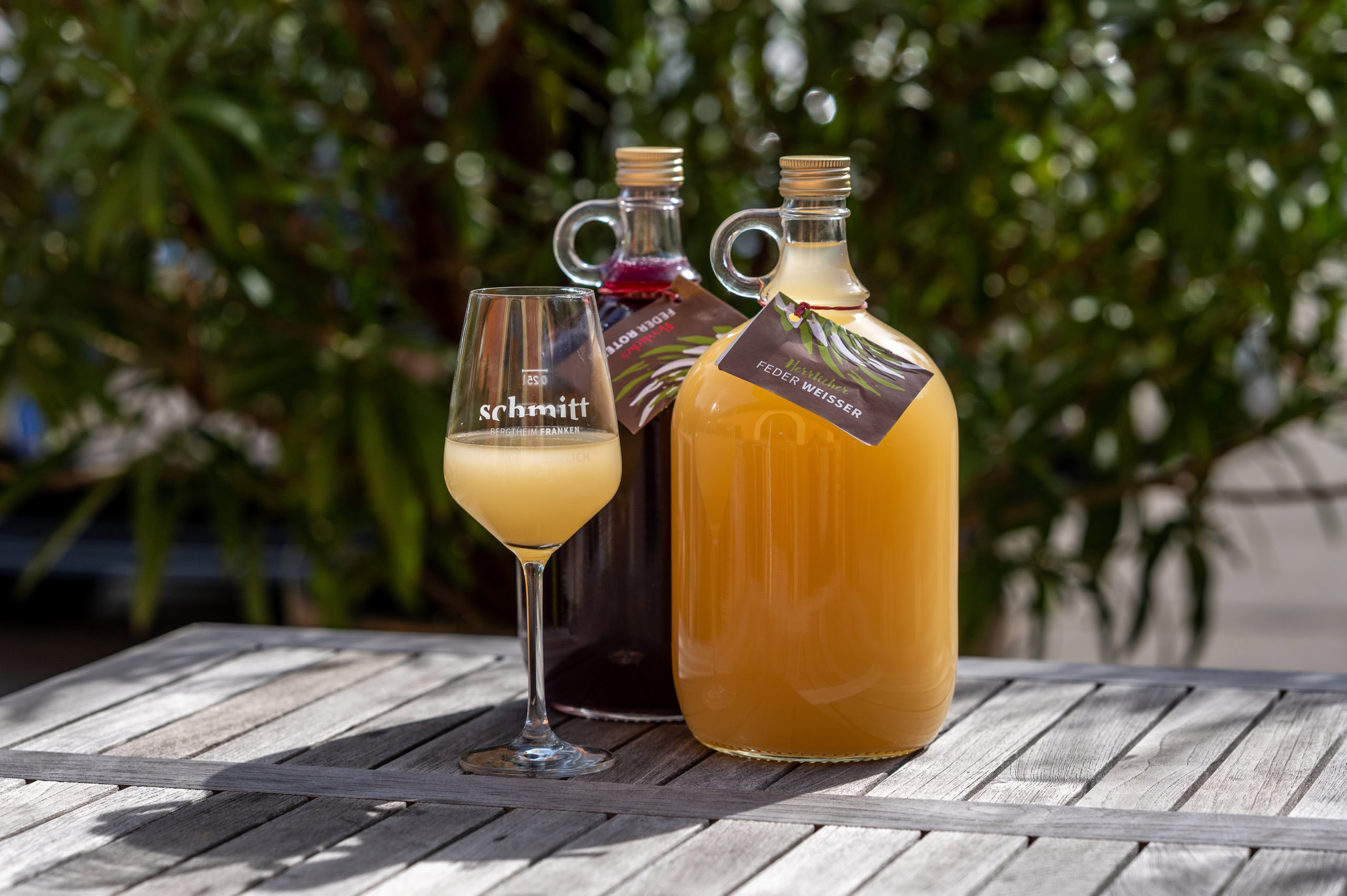
Federweißer and Federroter, photo credit: Weingut Schmitt
A bottle of wine is a foregone harvest, a transmuted measure of the soil, sun, and rain that fed erstwhile grapes. Federweißer, however, is an immediate taste of the harvest. In 2007, I was fresh out of college and living in Mainz, Germany, a gateway to major wine regions like the Rheingau and Rheinhessen, when I first encountered the young, sweet, low-alcohol wine called Federweißer and its red counterpart, Federroter. It was late summer when wooden stalls selling Federweißer materialized throughout the pedestrianized city center. There, I had my first swigs alongside Zwiebelkuchen, a flaky onion tart with a caramelized…
Adam H. Callaghan is a New England–based editor and writer who speaks fluent German and has lived in Munich, Mainz, and Freiburg. He contributes to such publications as Food & Wine, Fodor’s, and Punch.
What do one of the Mosel’s oldest winemaking estates and a country with a fledgling wine-drinking culture have in common? The answer, as with most things in life, is Riesling. “German Riesling has become a synonym for white wine in Finland,”” says Heidi Mäkinen MW, Portfolio Manager for Viinitie Oy, one of that country’s largest importers of German wine. “Finns like the freshness and fruit, and Riesling is one of those wine words that’s incredibly easy to pronounce.” As Viinitie’s new portfolio manager, Mäkinen, for whom work and private life has little separation, has kicked off her holidays 2,000 kilometers south of her…...
As more cool-climate regions like Germany's Mittelrhein seek grapes that can beat the heat, the rare Swiss variety Petite Arvine offers a surprising possibility.
Sekt embodies free spirit, hedonism, even — in its blatant disregard for rules — punk. The limitless maximization of lust for life and the unadulterated joy of the sensual assume the spotlight, while ethics and morals are asked to exit stage left. Whether it’s to christen a ship, toast a victory, or celebrate a birthday in the office (back when we did things like this), bubbles embrace the sparkling side of everyday life. A flash of glam on an otherwise wretched Tuesday afternoon. Sekt is bound to nothing and to no one, neither to food nor occasion. And that’s why…...
People imagined him to be an alchemist. Granted, it wasn’t gold his slender hands were currently molding, rather a gleaming tinted zinc capsule, encompassing perfect angles and gracing the long slender neck of a curvaceous body. While such language might seem passé in 2021, the characters who regularly participated in such frolics were not. Many were successful, most of them hailing from families older than the states whose passports they’d carry in their bespoke suits. Make no mistake: even here, the wealthier they were, the less attention to proper attire; and don’t let us get started on the unshaven angel…...