Her child, she thinks, is a Riesling. Of all the varieties in the world, she inevitably returns to this one. There is something in the grape’s singular ability to convey fragility and strength, ephemera and eternity, that mirrors motherhood and frames the child in her mind’s eye. The child could have reflected a multiple of varieties, a blend perhaps, or a different hue. She remembers a strawberry-scented evening of pink Cinsault in a South African game lodge, bottomless glasses as sundowners, followed by a queasy morning-after, and a realization that the child — then little more than a flicker —…
Born in Madrid, brought up in Paris, Clare went to boarding school in the UK but lived for the holidays and the flights ‘home’ with her brothers to her Diplomat parents whose work took them to more colorful destinations including Mexico, Belgium and Poland. Four years at Cambridge University immersed in French and Spanish literature were halcyon. She left with a future husband but no idea what to ‘do’ in the world, so turned to wine. She has worked as a wine buyer, seller and story-teller ever since, travelled the world, met fascinating people involved in wine of all nationalities including Chinese pirates and Russian spies, and cemented a true passion for all things vinous. In 2014, Clare and her family moved near Napa where she works full time as a wine buyer, often driving up and down the Silverado Trail. She is the California correspondent for Decanter.com and has had pieces published by Tim Atkin MW and the Academie du Vin Library. Much to her huge joy, Clare became a Master of Wine in February 2021.
Sekt embodies free spirit, hedonism, even — in its blatant disregard for rules — punk. The limitless maximization of lust for life and the unadulterated joy of the sensual assume the spotlight, while ethics and morals are asked to exit stage left. Whether it’s to christen a ship, toast a victory, or celebrate a birthday in the office (back when we did things like this), bubbles embrace the sparkling side of everyday life. A flash of glam on an otherwise wretched Tuesday afternoon. Sekt is bound to nothing and to no one, neither to food nor occasion. And that’s why…...
A fresh crop of Masters of Wine was announced late last month: Ten individuals who have grasped the holy grail of wine education. Among them is Moritz Nikolaus Lüke of Bonn — the tenth German to achieve the distinction. He joins an elite crew who have earned the title by passing legendarily rigorous blind tasting examinations and writing a series of theory papers as well as a research-based thesis. TRINK caught up with Lüke to find out what the experience was like, learn about his Covid-driven research paper — and get an answer to the question we’re all naturally most curious about: what he drank…...
“Die Luft war raus.” The spark had vanished; the bloom was off the rose. That was the phrase circulating in the weeks before ProWein opened, in emails, on the phone, in the particular silence that greets an appointment calendar nobody has the energy to open. Executing pre-fair rituals felt like a chore. My cowboy boots weighed heavy; my playlists, uninspired. And I wasn’t alone. Wine Paris closed its seventh edition in February with 63,541 trade visitors from 169 countries, up 21 percent in a single year. My social media feed was full of smiling faces and hand-lettered “Bonjour! Bienvenue!” signs,…...
“Free your mind and the rest will follow.” Coming from one of the co-owners of Germany’s oldest wine trading houses, one might suspect a quote from Goethe, Schiller, or Nietzsche. It’s actually the American R&B/pop group, En Vogue. And that makes for a jarring, if fitting, introduction to my conversation with these stewards of tradition in German wine that look back to 1786 in Worms as easily as they look ahead to 2019 Organic Madonna. P.J. Valckenberg has the history and the pedigree, no question. Its customers have included the Swedish royal family and Charles Dickens. In addition to a truly impressive portfolio…...
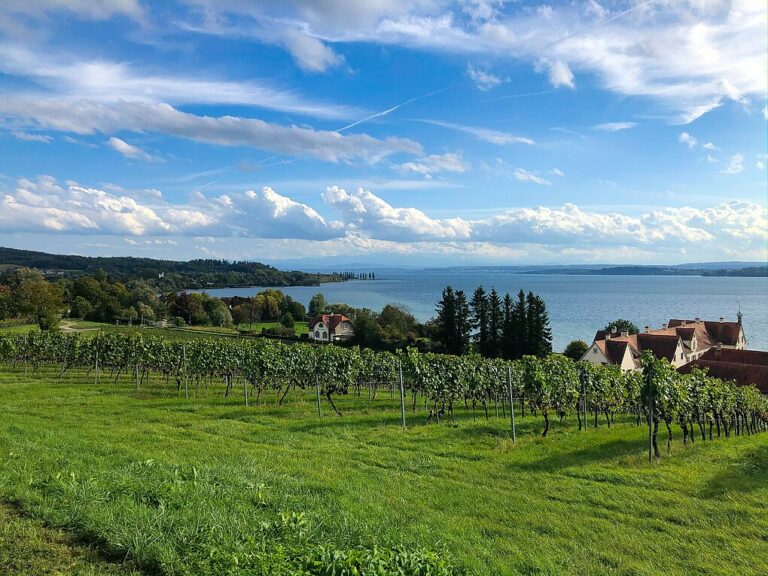
Ask a German about their favorite domestic vacation spots and Bodensee — aka Lake Constance — routinely sits near the top of the list. The country’s largest lake offers plenty of water and winter sports, proximity to Switzerland and Austria, the island of Mainau, and the Reichenau peninsula with its medieval history and churches. Then ask about dream winegrowing destinations, and watch Bodensee slip way, way down the list. With a reputation for simple wines that do little more than embody lake life, it is no wonder that in recent times Bodensee has struggled to be taken seriously. But a small group of young…...
Müller-Thurgau was a blessing and a curse for 20th-century Germany. Emily Campeau asks whether new respect from growers can make a contender in the 21st.