

David Schildknecht

Avatar photo
  • But for that Umlaut

    The spelling of grape names can be fraught. Iconic viticulturalist Georg Scheu once delivered an address, accompanied by a poem, wittily satirizing those who would replace Sylvaner’s romance “y” with “i.” In 1940, that was risky. Scheu’s country had become a terror state, and those being spoofed weren’t known for their sense of humor. Pfalz vintner Rainer Lingenfelder long labeled his Sylvaner: “Ypsilon – Homage to Georg Scheu and his Rebellion against the ‘i’-dot Bureaucrats [i-Punkt Bürokraten]” — which gained hilarity in translation given the fatuous Nazi policy of enforcing “Germanic” spelling. (Even the “c”s in Cabinet and Bernkasteler Doctor…...
    Membership Required

    You must be a member to access this content.

    View Membership Levels

    Already a member? Log in here
  • ·

    In Conversation with Michael Moosbrugger, Part II

    ​It’s hard to think of any one who has had greater influence over where Austrian wine is heading than Schloss Gobelsburg proprietor and Austria’s Traditionsweingüter (ÖTW) chairman Michael Moosbrugger. In part two of their conversation, David Schildknecht sounds out Moosbrugger on classification, appellation, and how music can illuminate wine. The following interview – translated and edited by the interviewer – was conducted in writing as well as orally in spring 2022. Occasional excerpts from earlier conversations and correspondence have been interpolated. Consolidation under topical headings as well as the insertion of punctuation were at the interviewer’s discretion in an effort…...

    Membership Required

    You must be a member to access this content.

    View Membership Levels

    Already a member? Log in here
  • Releasing the Power of Hidden Sweetness

    “Dry” describes what wine drinkers overwhelmingly profess to desire. And “trocken” can only appear on labels of German Rieslings with less than 10 grams of residual sugar.  If one desires sweetness, there is no lack: Most of today’s Kabinetts are higher in sugar than were Auslesen of the 1980s. (Granted, the grapes were probably also higher in must weight.) Aesthetically as well as commercially, success in the realm of legal dryness—Trockenheit—as well as that of pronounced sweetness, can scarcely be denied. German Riesling growers have long since succeeded in proving that they too can render world-class dry wine, while simultaneously…...

    Membership Required

    You must be a member to access this content.

    View Membership Levels

    Already a member? Log in here
  • · · ·

    Kabinett Trocken: Oxymoron or Opportunity?

    It’s an unfortunate paradox: the very climatic conditions that leave us thirsting for lightweight, refreshing and soul-satisfying dry wines render these hard to achieve. Yet, rather than leading the way in surmounting this viticultural challenge, Germany’s Riesling establishment routinely throws up roadblocks. That’s a crying shame.  THE CURIOSITY OF “KABINETT” To understand what’s become of “Kabinett trocken,” we must first retrace the steps leading to “Kabinett.” “Cabinet,” as a term applied to German Riesling, dates to 18th-century Rheingau, a derivative of “Cabinetstück” (alternatively, “Kabinet[t]stück”), in use for diverse objects worth displaying in a cabinet of curiosities or, by extension, worthy literary and…...

    Membership Required

    You must be a member to access this content.

    View Membership Levels

    Already a member? Log in here
  • · ·

    In the Sign of Subtlety

    Pinot Blanc is neither a distinctive cépage nor a particular grape variety – at least, not from the viewpoint of ampelography or genetics. And what there is of pure Pinot Blanc worldwide is nearly all rendered in German-speaking growing regions where it is typically known as Weissburgunder.

    Membership Required

    You must be a member to access this content.

    View Membership Levels

    Already a member? Log in here
  • · ·

    Dolomitic Dynamo: Weingut Abraham

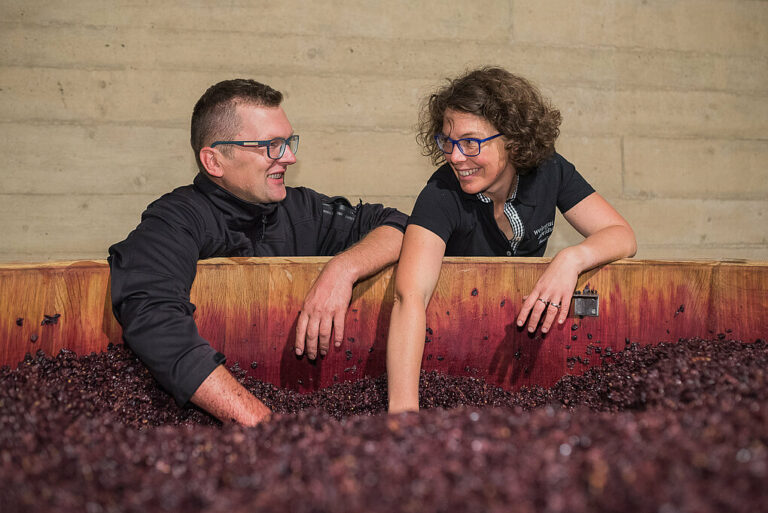
    My first, late spring 2018 visit with Marlies and Martin Abraham in their cellar on the edge of Eppan-Appiano proved an inspirational personal discovery. A young couple leaves behind former professions to follow a vinicultural dream of activism in the vineyard and minimalism in the cellar, becoming the first to vinify and bottle wine from the vineyards they have inherited: In itself, that story is nowadays (thankfully) far from unusual. But in Südtirol-Alto Adige, it’s an audacious exception. Moreover, I was amazed by how distinctly delicious were Abrahams’ interpretations of each among the four grape varieties they chose to champion, especially considering…...

    Membership Required

    You must be a member to access this content.

    View Membership Levels

    Already a member? Log in here