The quiet whirr of my high-speed German train is a soothing reminder of Europe’s classy public transit I so miss in America. I’m headed south from Frankfurt towards a gentle landscape of vineyards, orchards and villages near the Rhine River and my Jewish father’s hometown. I’m much less comfortable with the muted conversations surrounding me. Like many children of Holocaust survivors, I grew up instinctively wary of the German language and all things German. I’m on a symbolic journey alone back to Landau, the market town where my grandfather Heinrich Levy was a winemaker in the Pfalz in 1920s and ‘30s,…
Based in San Francisco, Ruth Landy is a writer and second-generation Holocaust survivor. Drawing on a career in documentary filmmaking and global advocacy for WHO and UNICEF, her work has been published in The Guardian and Whetstone magazine. Ruth is currently writing a memoir about her Holocaust inheritance, exploring the powerful role of her family’s food and wine heritage in transmitting memory and strengthening bonds.
Editors’ Note: Data open tantalizing invitations to speculation. Wine economist Dr. Karl Storchmann of the American Association of Wine Economists is a master at collecting information, presenting it in clear, compelling graphics, and stepping away to allow each of us to draw our own conclusions. When he looked at wine, beer, and spirits consumption in three of TRINK’s coverage zones over the past century, he found striking disparities and a surprising convergence. What story do they tell you? Per capita wine consumption in Austria, Germany, and Switzerland has fluctuated significantly since the late 19th century (see Figure 1). Switzerland has…...
Don’t let anyone tell you those rocks are a waste of time. Twenty-five years from now, sitting in a Koblenz classroom on your first day of wine school, you will be grateful for each and every one of them. Because there in the heart of German wine country, those stones and their secrets — though you don’t know it yet — will be the foundation keeping you steady among your more experienced classmates, those vintners’ sons and daughters who boast seven, ten, 15 generations in the business, and counting. All while you are still trying to locate the Mosel on…...
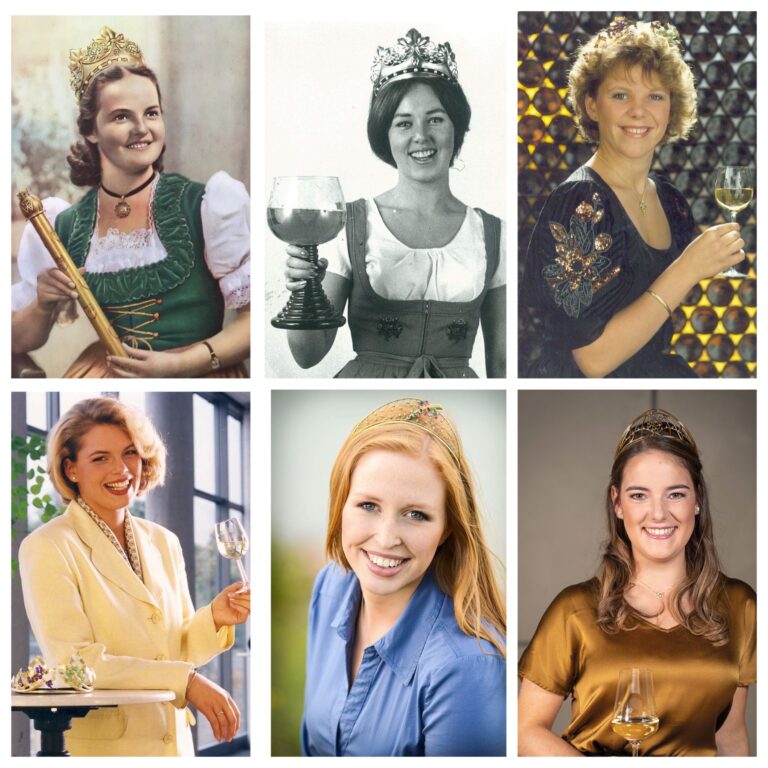
The story starts with a pedicure and a camping van. Each year when the German wine queen visits New York City, Paul Grieco treats her to a pedicure. (If the queen’s mother is also visiting, she gets one, too.) Grieco is a sommelier, vocal Riesling advocate, and owner/manager of Terroir wine bar in New York. He is also part jester, reveling in the micro-tradition of the pedicure while also pointing toward the intellectual esteem in which he holds every queen he’s ever met. Grieco honors the queens, he said, “because we [at Terroir] are fans of history and culture and [the queens] are an…...
We’ll come right out and say it: Franken (Franconia) is Germany’s most underrated region. If you still think of it as the source of wan wines poured from squat flagons and drunk mostly at home, we’re here to let you in on a secret: there has never been a more exciting time for this corner of northern Bavaria, where wine, not beer, rules the day. The region sits just below the 50th parallel and at the cool, eastern edge of Germany’s wine core. It’s a perilous position for viticulture. As decades of frost-crimped and extreme-heat-affected vintages attest, its starkly continental…...
While artists throughout the ages have longed to catch time in a bottle, it is winemakers who have indeed come closest to achieving this noblest of goals. A fine wine captures not just a single moment, but the span of a vintage, a lifetime, of eons of geology. A liquid suspension of sugar, acids, ethanol, tannins, phenolics, and chemical compounds can become a remarkable crucible of climate, soil, and vision. Yet unlike many other artistic disciplines, there is no fixed point at which the winemaker can lay down his pen or her brush and declare the bottle finished. There are certainly…...