“Dry” describes what wine drinkers overwhelmingly profess to desire. And “trocken” can only appear on labels of German Rieslings with less than 10 grams of residual sugar. If one desires sweetness, there is no lack: Most of today’s Kabinetts are higher in sugar than were Auslesen of the 1980s. (Granted, the grapes were probably also higher in must weight.) Aesthetically as well as commercially, success in the realm of legal dryness—Trockenheit—as well as that of pronounced sweetness, can scarcely be denied. German Riesling growers have long since succeeded in proving that they too can render world-class dry wine, while simultaneously…
David Schildknecht trained in philosophy and worked as a restaurateur before spending a quarter century in the U.S. wine trade. His tasting reports, ones from Austria and Germany prominent among them, have since the late 1980s been fixtures of Stephen Tanzer's International Wine Cellar; Robert Parker's Wine Advocate; and, since 2015, Vinous. A columnist and feature contributor for Wine & Spirits, The World of Fine Wine, and Austria’s Vinaria, he is responsible for the German and Austrian entries in the The Oxford Companion to Wine and a co-author of the 7th edition of Robert Parker's Wine Buyer's Guide. David has also addressed issues of aesthetics in contexts academic and otherwise, and his life in wine leaves time to pursue his passions for cooking, music, history, and his infinitely tolerant wife of five decades.
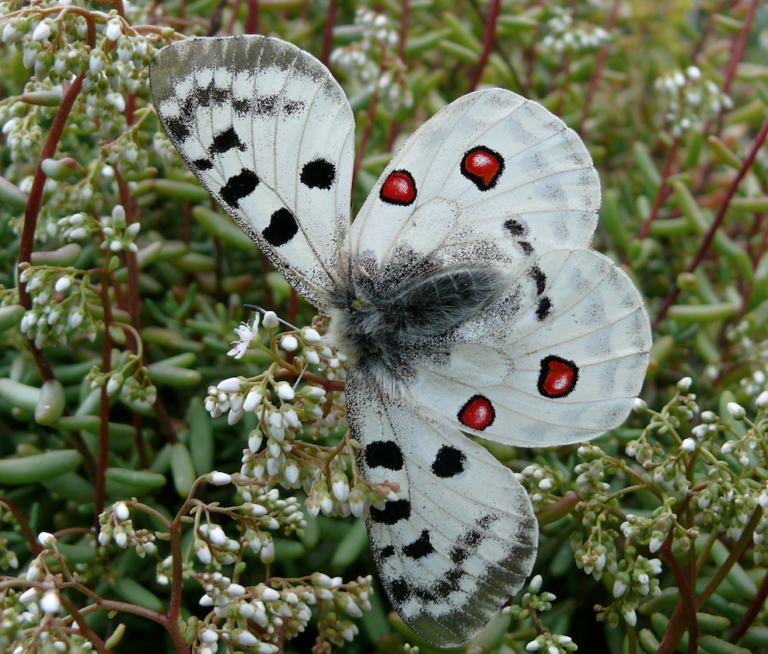
The future of the Mosel Apollo butterfly and its habitat of the Mosel terraces are endangered. Can a solution be found that allows both to continue to coexist?
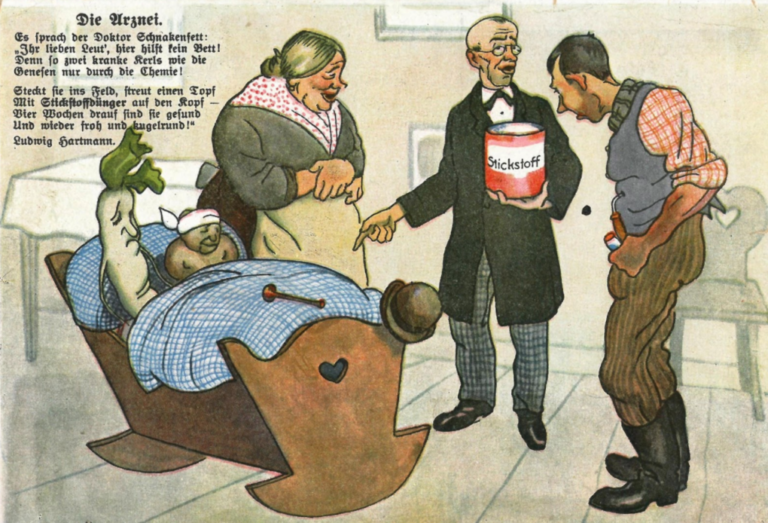
Above, a postcard from the German fertilizer industry of the 1920s. At the time, perspectives on soil were changing: Until then, people had spoken of plant growth as being affected by forces; afterward, it was substances. Deficiencies could simply be addressed with the help of agrochemistry. As recently as a decade ago, biodynamic viticulture could be shrugged off as “some dogma about phases of the moon and cow horns.” But now that we find a who’s who of the wine world on the member lists of relevant biodynamic organizations, it’s no longer so easy to cancel adherents to this form of farming. Those…...
For a Jewish baby boomer like me, the Holocaust was always part of my DNA. Yet, I was not the child of survivors. My Polish grandparents were safely in the United States by the 1920s. The family they left behind were mostly killed. In yeshiva, where I spent a dozen years splitting my curriculum between religious and secular studies, we were frequently subjected to footage of emaciated bodies, piled up for burning or disposal. Teachers didn’t hide the numbers tattooed on their arms. But the personal horror stories my cousins told of Polish concentration camps and ghettos were the images…...
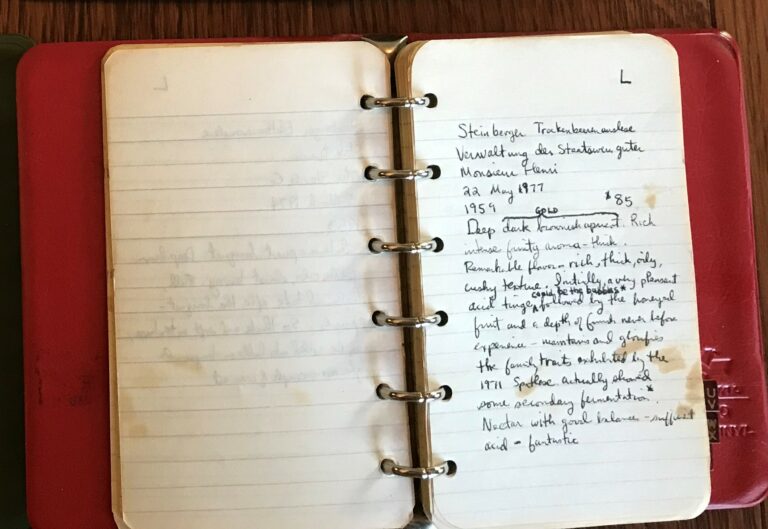
My twenty-something self left two gifts for the older man I would become: a doctorate in applied mathematics and four small, looseleaf notebooks. The degree opened many doors and reinforced my ability to do independent research, perform analyses, and document the results. The notebooks, along with labels from many of the bottles, form an archive of my first decade tasting wine. Between 1969 and 1979, a period covering my student and early career years, I kept detailed notes on almost everything I tasted. During most of that time, I lived in Evanston, Illinois. It was dry until 1975, necessitating runs…...