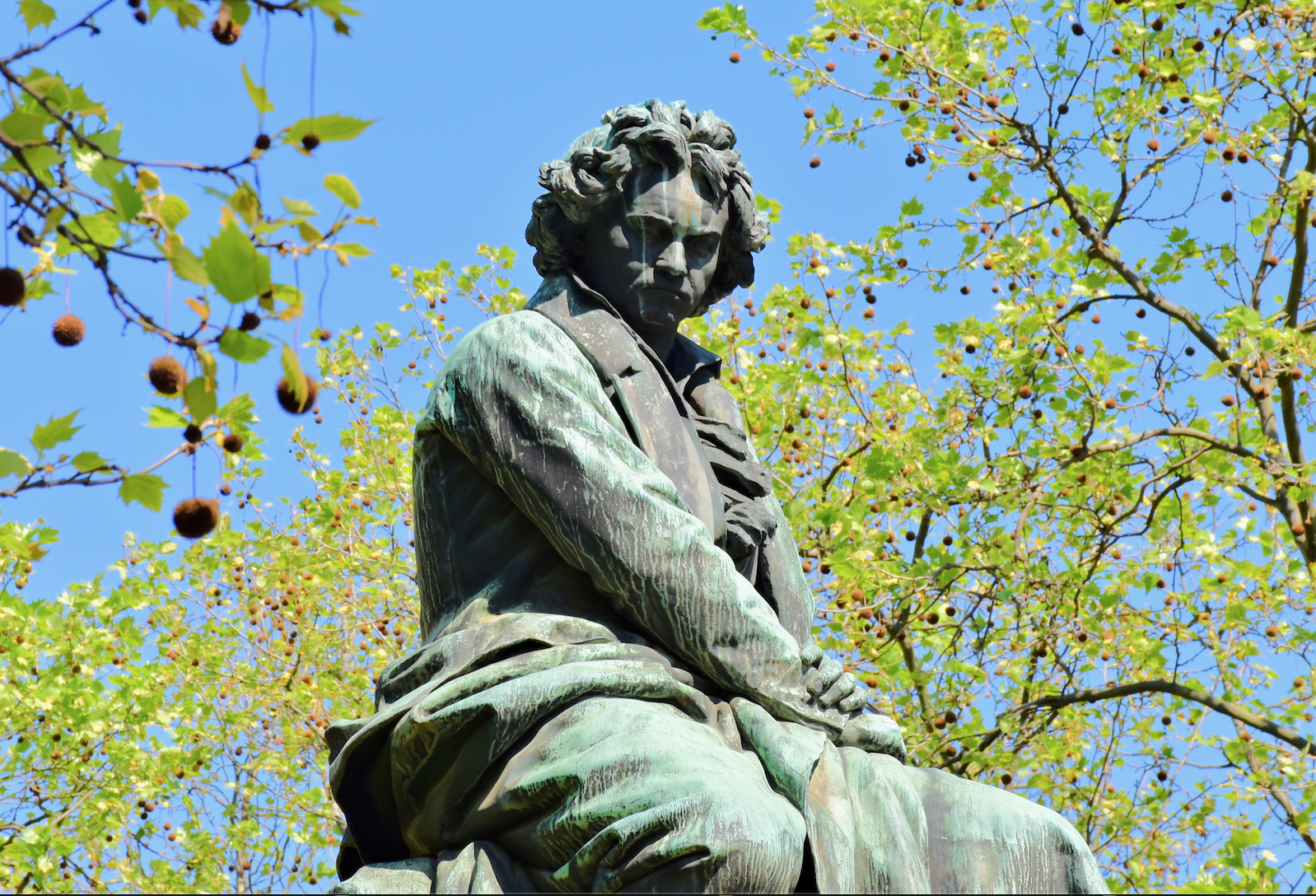
On the dark morning of March 26, 1827, a heavy snowstorm was falling outside the fogged window panes of Ludwig van Beethoven’s Vienna apartment. Everything was unusually quiet in this space, so customarily filled with music. Beethoven’s house servant walked into the room to announce that a long-awaited shipment of Rheingau Rieslings, wines sent at his behest by his music publisher Schott, had just arrived. Barely able to muster the energy, the composer sat up in his bed, shook his fist in anger, and muttered these very last words: “Pity, pity, it’s too late…” He sank back into his bed,…
Ron Merlino is a certified sommelier, and owner and manager of MusicVine Performing Arts and Wine Consulting. He is at work on an extensive history of wine in the lives of the great Viennese composers from the 18th to the early 20th century — from Mozart and Haydn through Beethoven and Schubert to Brahms, Mahler and beyond. Ron is developing a televised series on wine and the great composers of Germany with MDR Radio and Television Leipzig and is a contributor to BBC Radio 3. He is also collaborating with the Beethoven Haus Bonn in Germany on an extended project highlighting the narrative of wine in Beethoven’s life. BBC Radio 3 and the National Symphony Orchestra of Wales hosted a live event with him on Beethoven and his wines in January 2020. Prior to his professional work as an artist manager, Ron served as Director of Artistic Planning for the San Francisco Symphony, the New York Philharmonic, and the Indianapolis Symphony Orchestra in addition to positions on the artistic staffs of the Baltimore Symphony, the American Symphony Orchestra and the Orchestra of St. Luke’s.
The year is 1806. The date June 17th. Privy Councilor Goethe sits in Frankfurt — high and dry. He reaches for his quill and writes a letter to a friend: “Send me some Würzburger wine, for no other wine satisfies, and I am morose without my accustomed favorite drink.” While the line may not be poetic, the composition Johann Wolfgang von Goethe thirsted for is. The wine in question was, quite possibly, “Frentsch” (local dialect for Altfränkischer Satz or Old Franconian Mixed Set): a field blend of some 20 grape varieties, all planted, harvested, and fermented together. What once gave growers a bit of…...
The sun blazes. The air shimmers. On the horizon four figures throw long shadows across the dry, crumbling ground. They are headed toward a city. Doors swing open. The four step from light into dark, their throats dusty and dry. Behind a deserted bar stands a man. He pushes four full glasses over to them. Out of the glasses sloshes a wine as red as the setting sun. If you aren’t thirsty by now, you should at least be hearing the melody of a harmonica. This is how the opening scene of a revival—the Rotling revival—could begin. The four men…...
The intimate wine bar from Holger Schwedler, the size of a Texas walk-in closet, sat off a quiet pedestrian alley not far from the famous curative hot spring of Wiesbaden, the Kochbrunnen. Too small for a kitchen, the wine bar encouraged patrons to bring their own vittles, which, like the guests, included a variety...
It’s an unfortunate paradox: the very climatic conditions that leave us thirsting for lightweight, refreshing and soul-satisfying dry wines render these hard to achieve. Yet, rather than leading the way in surmounting this viticultural challenge, Germany’s Riesling establishment routinely throws up roadblocks. That’s a crying shame. THE CURIOSITY OF “KABINETT” To understand what’s become of “Kabinett trocken,” we must first retrace the steps leading to “Kabinett.” “Cabinet,” as a term applied to German Riesling, dates to 18th-century Rheingau, a derivative of “Cabinetstück” (alternatively, “Kabinet[t]stück”), in use for diverse objects worth displaying in a cabinet of curiosities or, by extension, worthy literary and…...
Home is where the vines grow. We’ve all heard variations on that theme. But just how far can that idea be taken? WeinGoutte offers one answer. This portable micro-estate — whose first vintage sold out in a blink — is the brainchild of husband-and-wife team Christoph Müller and Emily Campeau. The concept goes beyond negociant but stops well short of flying winemaker. It also presents an entirely new model for a footloose generation’s interpretation of the relationship between vintner and site. Campeau, a fierce lover of food and wine (and a vivid writer on both), is originally from Québec. Her experiences in…...