Editors’ Note: Data open tantalizing invitations to speculation. Wine economist Dr. Karl Storchmann of the American Association of Wine Economists is a master at collecting information, presenting it in clear, compelling graphics, and stepping away to allow each of us to draw our own conclusions. When he looked at wine, beer, and spirits consumption in three of TRINK’s coverage zones over the past century, he found striking disparities and a surprising convergence. What story do they tell you?Per capita wine consumption in Austria, Germany, and Switzerland has fluctuated significantly since the late 19th century (see Figure 1). Switzerland has consistently…
Karl Storchmann has been a Clinical Professor of Economics at New York University since 2009. He holds a Ph.D. in Economics from the University of Bochum in Germany (1998). Dr. Storchmann is a co-founder and the Editor of the Journal of Wine Economics, and the Executive Director of the American Association of Wine Economists (AAWE). He has taught or held permanent or visiting positions at various universities, including UCLA, Yale University, and Bordeaux Sciences Agro (2014–present). He is an applied microeconomist whose research focuses on environmental and industrial organization issues related to agriculture and the wine market. His most recent work examines the effects of tariffs on the wine industry. He has published wine-related papers in academic journals such as Agricultural Economics, the American Economic Review, Economic Inquiry, the Journal of Wine Economics, the Review of Economics and Statistics, and the Review of Industrial Organization.
Melanie Broyé-Engelkes, a seasoned marketing executive and entrepreneur from Paris and Luise Böhme, a former nationally competitive athlete from eastern Germany, have joined Theresa Olkus, a communications specialist from Württemberg, to form a triumverate that — in ways large and small — now steers the future of German wine.
As more cool-climate regions like Germany's Mittelrhein seek grapes that can beat the heat, the rare Swiss variety Petite Arvine offers a surprising possibility.
The Pfalz is Germany’s second-largest wine region (by volume) — and perhaps its biggest surprise. The south-of-the-Alps feel of abundance and harmony stems from geographic confluence, where the sheltering Haardt mountains meet Rhine river plain. With Rheinhessen to its north and Alsace due south, it’s a wholly unexpected idyll of fig, lemon, and almond trees, pastel villas, and gentle vine-wrapped slopes as far as the eye can see. Amid this beauty, the Pfälzer live with French-inflected savoir-faire. This amplitude is all there in the wines. Within a compact 85-km north-south span, 130 villages and seemingly countless vineyards are tightly packed north to…...
The 45-kilometer Zellertalweg hiking trail runs through the heart of the Zellertal. I have created a loop trail that builds off of this longer path and can be divided into several stages. It takes in the best-known vineyards and some of the most interesting sights featured in my forthcoming wine travel guide to Germany. For me, this is the most beautiful part of the Zellertal, naturally including the Schwarzer Herrgott in both the Pfalz and Rheinhessen. As my route diverges from the Zellertalweg at several points, use this downloadable GPX file to navigate. (Works with any standard phone-based hiking app…...
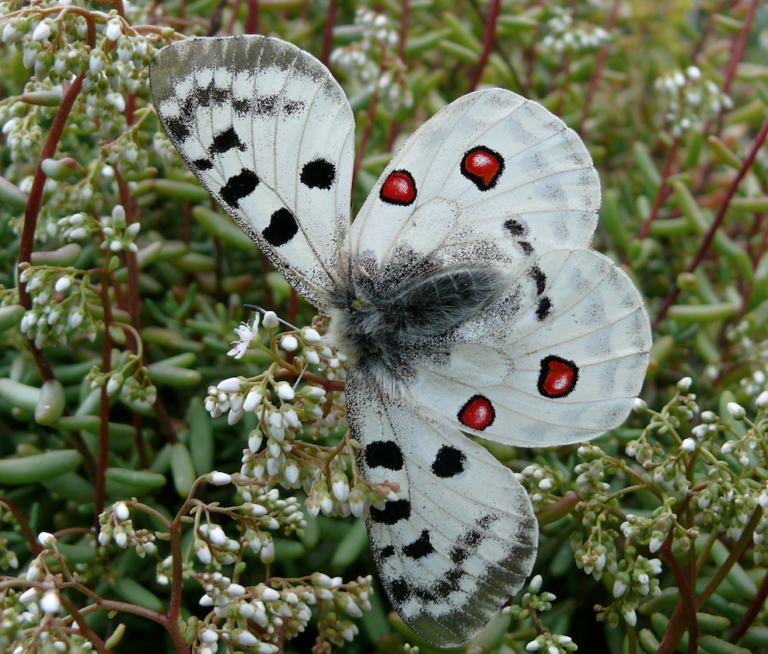
The future of the Mosel Apollo butterfly and its habitat of the Mosel terraces are endangered. Can a solution be found that allows both to continue to coexist?