Not long ago, in my merchant days, I scored a few cases of mature Mosel wines from a grower I didn’t know. It wasn’t much wine, the prices were attractive, and I was able to eke out a few bottles for my cellar, which can never have too many ready-to-drink Rieslings. They were 1982s and 1985s. I had a wine friend over and opened one of the bottles to begin the evening’s festivities. “Oh I do like old Riesling,” my friend said, “And isn’t it amazing how well even a Kabinett can age?” “It is indeed,” I said. “But this isn’t a…
After several decades as a wine merchant, Theise has returned to his first love, writing, and to contemplating how a poorly educated oaf with no personal graces could have achieved even the meager level of success he managed to attain. Find his latest work terrytheise.com
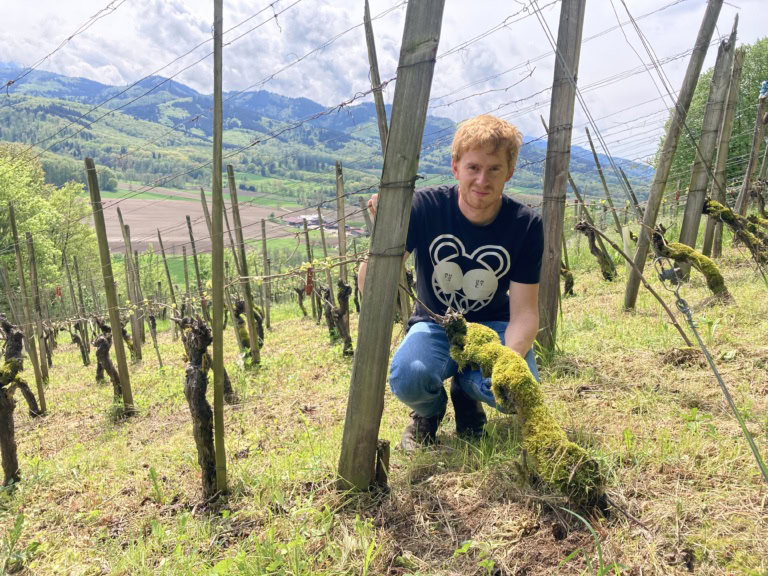
It is a landscape rife with charms and challenges: From their perch atop the Oberrotweiler Eichberg, on a long-dormant volcano that rises to 310 meters, Johannes Landerer and Jakob Moise can enjoy some of the finest views over the Kaiserstuhl and sprawling Rhine Basin in Baden. The early morning sun is quickly rising, but the Kaiserstuhl, normally a place of striking warmth, has seen an unusual amount of precipitation in the summer of 2024, leaving it greener than at any time in recent memory. But if this pair of Kaiserstuhl winegrowers agree on anything, it’s that this situation is likely…...
In the first movement of this piece, we looked at the origins of Ludwig van Beethoven’s interest in wine and the critical role this played in shaping the composer’s musical career. Here, we trace his path through Vienna’s living landscape, to find multiple points of intersection between past and present in his music and in some of the city’s defining wines. We then head south to the Austrian spa region of Baden, where Beethoven drank, and composed, masterpieces. As we will find, his music comes more vividly to life when appreciated within the context of the vines and landscapes in which it was written…...
André Gussek remembers very clearly how it all got started: Right around the time he was hired as cellar master at the historic eastern German Kloster Pforta winery in 1982, “the first Spätburgunder vines, West German clones obtained via foreign trade,” arrived at the estate in Naumburg an der Saale, roughly 60 kilometers from Leipzig and some 220 kilometers from Berlin. “In the fog of history, it was difficult to see precisely where they came from,” Gussek explains with characteristic calm. Much clearer is what they became: a catalyst for red wine to assume “an ever-larger role” in the former…...