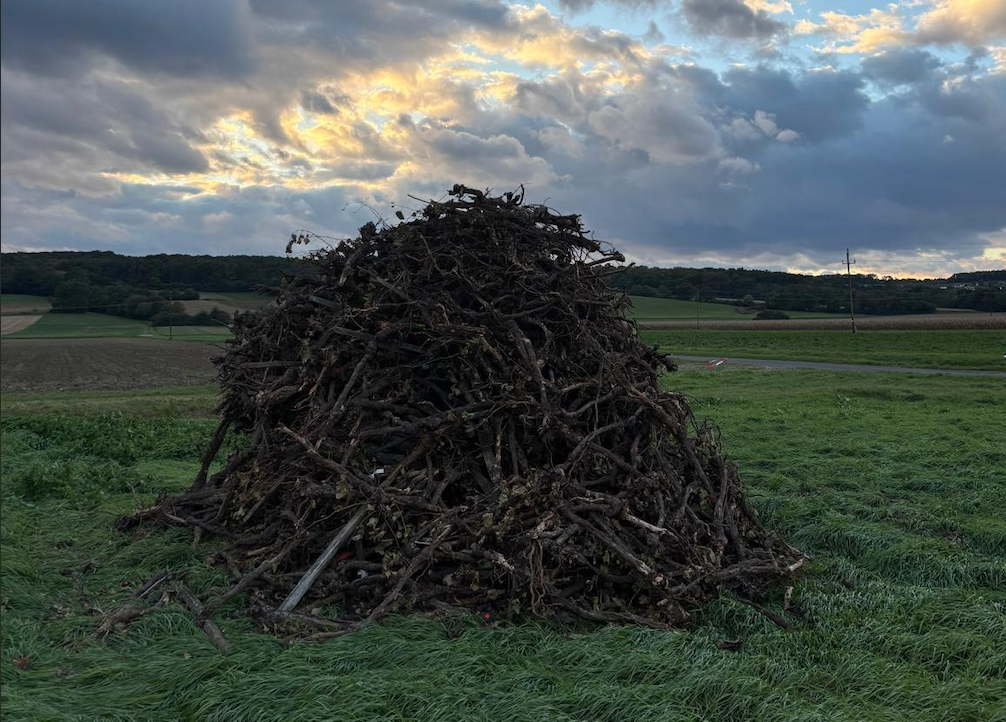
A pile of culled vines, infected with Goldgelbe Vergilbung; photo credit: Wachter-Wiesler
In slanting early morning light, a shadow crosses a vineyard. The figure moves row by row, ripping out vines and casting them onto a large, burning pyre. The blaze stretches to greet the sun as it rises above a mountainous horizon. There is fire from all points of the compass. Death is in the air. The culprit is a phytoplasm fatal to Vinifera vines. Its spread is aided by the American grapevine leafhopper (Scaphoideus titanus), a dwarf cicada native to North America. As it feasts on the vines, it transmits the pathogen of what is known in German as Goldgelbe…
Kevin Puls works in advertising and PR. His passion for Austrian wine began nearly two decades ago and he's regularly tasted the vintages of the Alpenrepublik from the Wachau to Styria. His weakness for estates that work organically and for natural wines started with Gut Oggau's 2007 vintage. He's also a regular visitor to Franken. He blogs about food, wine, and the people who make them.
For most wine drinkers, Riesling and Grüner Veltliner are gateways to Austrian wine. But with Austria’s wide range of climates and geography, this tiny country offers surprising varietal diversity. Forty-two different wine grapes are native or traditional, with expressions ranging from light and vibrant to rich and baroque. Topping the list are varieties with long histories in Austria: the red grapes Blaufränkisch and Zweigelt, the whites Chardonnay (known in Austria as Morillon) and Sauvignon Blanc. Then there are the 22 grapes on the back half of the list, each accounting for less than 1% of total plantings. All these varieties…...
Silvaner. It’s complicated. Ask about its nature or character, and like as not you’ll get one answer: asparagus. With delicate vegetal aromas and moderate acidity, Silvaner is indeed a near perfect pairing for the fabled stalk that emerges from the earth to fill German grocery stores and market stalls annually between April and June. Yet, stop for a minute and imagine: what if there were more? Silvaner is viewed as a national counterpoint to Burgundian Chardonnay or Saumur Chenin Blanc. For many years Silvaner was Germany’s most important grape variety, less inclined toward fruity fun and more toward structure, texture, spice, and earth. De facto it…...
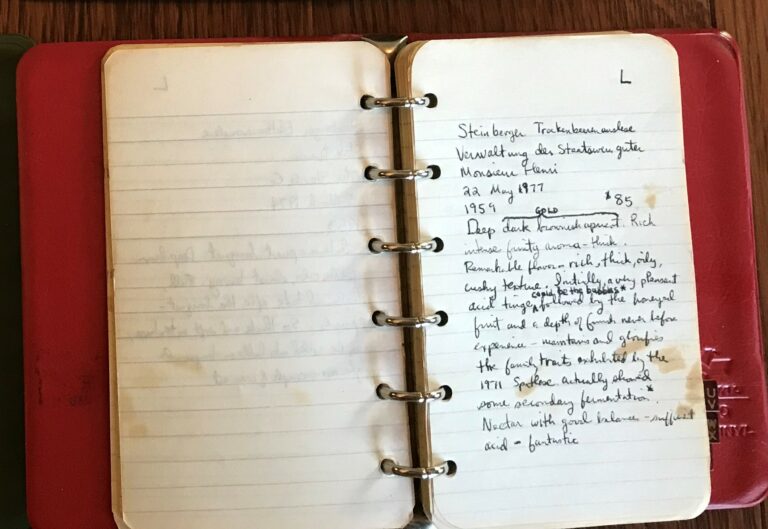
My twenty-something self left two gifts for the older man I would become: a doctorate in applied mathematics and four small, looseleaf notebooks. The degree opened many doors and reinforced my ability to do independent research, perform analyses, and document the results. The notebooks, along with labels from many of the bottles, form an archive of my first decade tasting wine. Between 1969 and 1979, a period covering my student and early career years, I kept detailed notes on almost everything I tasted. During most of that time, I lived in Evanston, Illinois. It was dry until 1975, necessitating runs…...
Over the last decade, Berlin has established itself as a wine city. No small feat, since little quality wine is made within a five-hour driving radius. But in the early 2010s the natural wine movement brought in “small plates and natural wine” bistros and more and more distributors — independent wine stores who both import and buy wines and then sell them to both restaurants and consumers alike — are basing themselves here. The RAW wine fair made Berlin its Central European hub back in 2015. Before March 2020, business was good. Then came Covid. Putting the Neighbor back in Neighborhood at…...
Zeter assesses the natural bounty of his home, the Pfalz, with the eye of a chef. The soils are his mise en place — the basis of his work — the grape varieties are the ingredients he brings to the table and the bottle. His favorite ingredient — Sauvignon Blanc — has become his trademark. This love came early: in South Africa, 1992, at the Buitenverwachting winery in Cape Town. Now, he is celebrating 15 years as a Sauvignon Blanc iconoclast himself. A recent vertical tasting spanning his first vintage in 2007 to the current release, 2021, made clear the value of following palate…...